
October 12, 2026
Preserve source authority, federate intelligence
Every system in an enterprise holds part of what the organization knows. This is the pattern Syncratic uses to connect those parts into trusted intelligence while every system keeps ownership of its own.
Syncratic
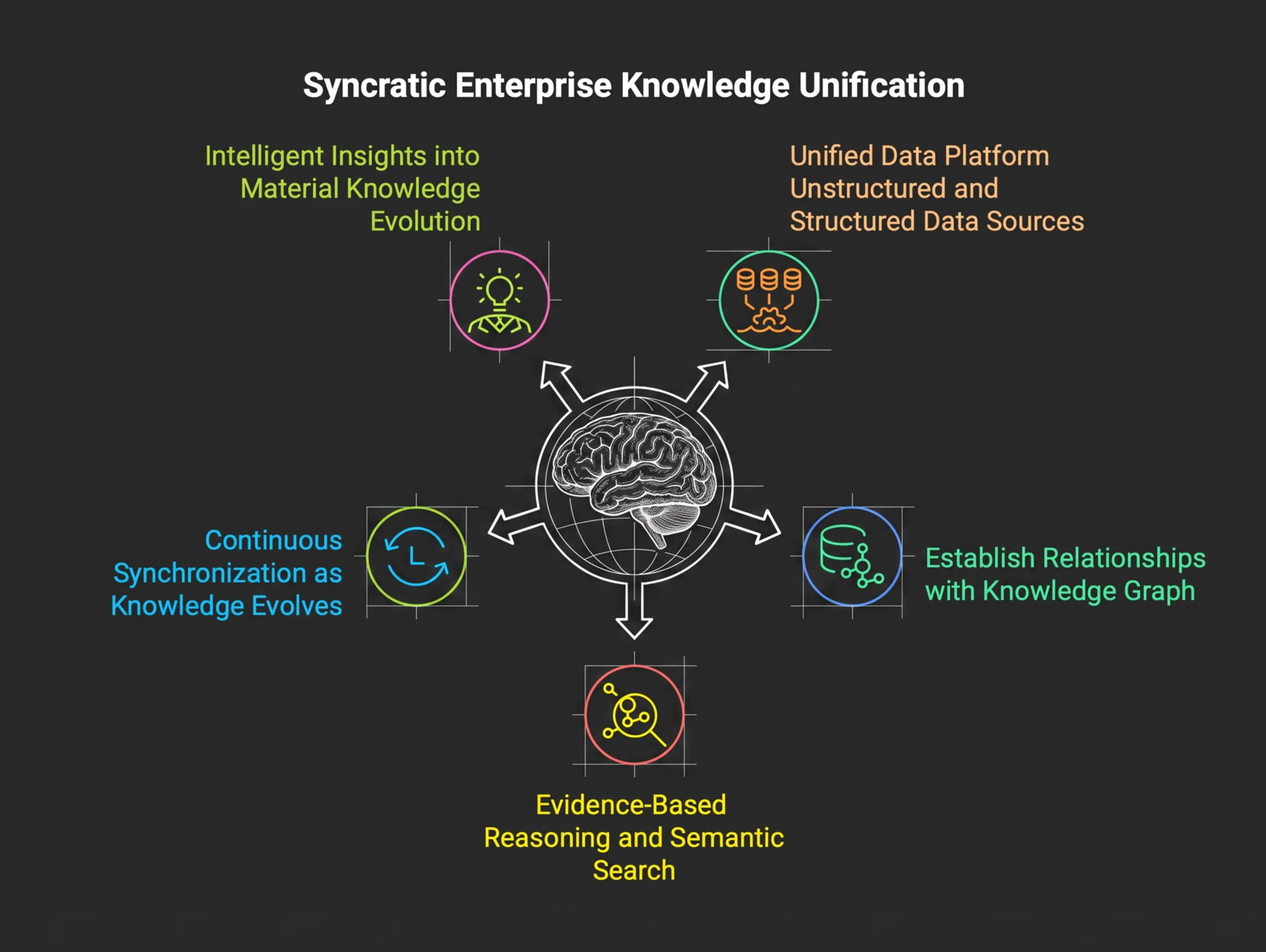
Every organization runs systems that each hold a piece of what it knows. The file repository holds its documents. The recording system holds what was captured. The registry holds the list of entities that matter. The records system holds the official paperwork. The applications people work in each day need knowledge from all of them, and the pieces live in separate places, guarded by separate access rules. Bringing the pieces together by hand is slow, and relying on knowing where to look is fragile. Useful enterprise knowledge needs the pieces connected, with clear rules about who can use what.
This post explains the pattern the Syncratic platform is built on, in plain terms: what it does today, and the direction it is designed to extend. The pattern has a name we find useful: preserve source authority, federate intelligence.
Preserve source authority, federate intelligence
Four kinds of authority show up whenever specialized systems must work together. Authority simply means the system that is right about its own facts:
- Source authority. The system that captured the data owns its content, its timing, and its versions.
- Domain authority. A registry owns the entities that matter, with a stable identity for each.
- Knowledge authority. A central engine owns what gets taken in, the connections between facts, and the rules for how knowledge can be used.
- Experience authority. The application owns what people see and do, and it behaves in a predictable way even when something goes wrong.
The pattern keeps each of these roles where it belongs. It exists because of a common integration mistake: projects copy every system’s logic into one place until it is no longer clear which system is right about what. The central engine takes the opposite shape on purpose. It connects the facts. Each source keeps ownership of them.
The shape of the problem
Picture a live financial broadcast. During it, a company announces a strategic change. An executive discusses supply constraints. An analyst revises an outlook on a sector. Several known companies come up across different segments. Later reporting supports some of the original claims and challenges others.
Capturing the words is the easy part. Turning them into intelligence that can guide decisions is the harder challenge, because a decision is only as good as the information behind it. Before anyone acts on a summary, they need answers to a few plain questions:
- Which version of the recording is the authoritative one, and which passage supports each claim?
- Who is allowed to see this evidence, and for how long does it remain valid?
- Which of the companies mentioned belong on the governed list, and how does this event relate to earlier documents?
- Can the summary be reproduced later, with the same evidence and the same context?
A recording system answers none of these. A central knowledge engine answers all of them, and the answers travel with the result, so the next decision starts from trusted ground.
What the central engine contributes
When new data enters the platform, for example a transcript of that broadcast, it crosses a controlled boundary. Inside, it becomes part of the organization’s knowledge: the official copy of the document, the evidence in it, the entities it mentions, and the connections between them, joined with everything the organization already holds from its other sources, ready for search and for questions.
Three properties carry most of the value:
Access rules travel with the data. A permission decision made at the first request must hold everywhere the data later appears: in search results, in the connections between entities, in generated output, and at eventual cleanup. This is what makes advanced AI features safe to use with private workspaces and evidence that belongs to a specific owner.
Every claim can be checked. A generated result records which document, which passage, and which rule contributed to it. A reader can move from any conclusion to the evidence behind it without leaving the governed boundary.
Results remember when. The platform records what was known at the time. A later review can separate what was known then from what is known now, and a replay reproduces the original result with its original context.
Failure is part of the trust model
Governed intelligence has clear behavior when things go wrong. When evidence is missing, the system says so. When a generated claim lacks supporting evidence, the system withholds it. When an application receives an incomplete or pending result, it falls back to safe, predictable behavior. Each of these is a deliberate product decision about trust. Together they make the system predictable at exactly the moment predictability matters most: when something has gone wrong.
Where AI models fit in
The lasting value of the architecture lives in the knowledge: what was taken in, the evidence behind it, the rules, and the connections between them. Models transform a defined set of evidence into structured output, and they do it through a governed AI gateway with policy and audit. That placement keeps model providers replaceable. The knowledge, the evidence, and the guarantees live in the platform. The model is one governed part among several, and a part can be exchanged without losing what matters.
One pattern across many domains
The same pattern extends to other live signals with the same shape: a specialized system captures them, a registry may govern the entities they mention, and an application needs intelligence backed by evidence from them. Financial broadcasts, earnings calls, regulatory hearings, incident response calls, and recorded interviews all fit. Every new source brings its own authority. Every new registry brings its own list. The knowledge engine connects them all through the same governed boundary.
This is what we mean when we describe Syncratic as a central knowledge and intelligence engine: a governed layer between systems that each know part of the truth, making the parts work together while each system keeps its authority.
If you want to see the platform connect your own data, structured and unstructured, request a demo.